
For a long time, website analysis started with the same question:
“What is wrong with this website?”
It is a useful question, but it does not tell the whole story.
Almost any website audit will find something to improve: a title that is too long, images without alternative text, a page that is too large, thin content, or a server response time that could be faster.
However, not every issue has the same impact. More importantly, not every issue deserves the same amount of time or money.
The more relevant question is:
How good does your website need to be to compete with the websites currently ranking above it?
That question led us to create the free CipDesign Competitor Comparison tool.
An Audit Shows You What Is Wrong. A Comparison Shows You Whether It Matters
Imagine that your website audit reports a server response time of 1,300 milliseconds.
Is that good? Is it bad? Should improving it become an immediate priority?
On its own, the number tells only part of the story.
If your competitors’ websites respond in approximately 240 milliseconds, you have identified a measurable disadvantage. If their performance is similar to yours, another issue may deserve your attention first.
Comparison provides context. And context turns a technical report into an actionable plan.
Your Website Versus the Competitors Ranking Above You
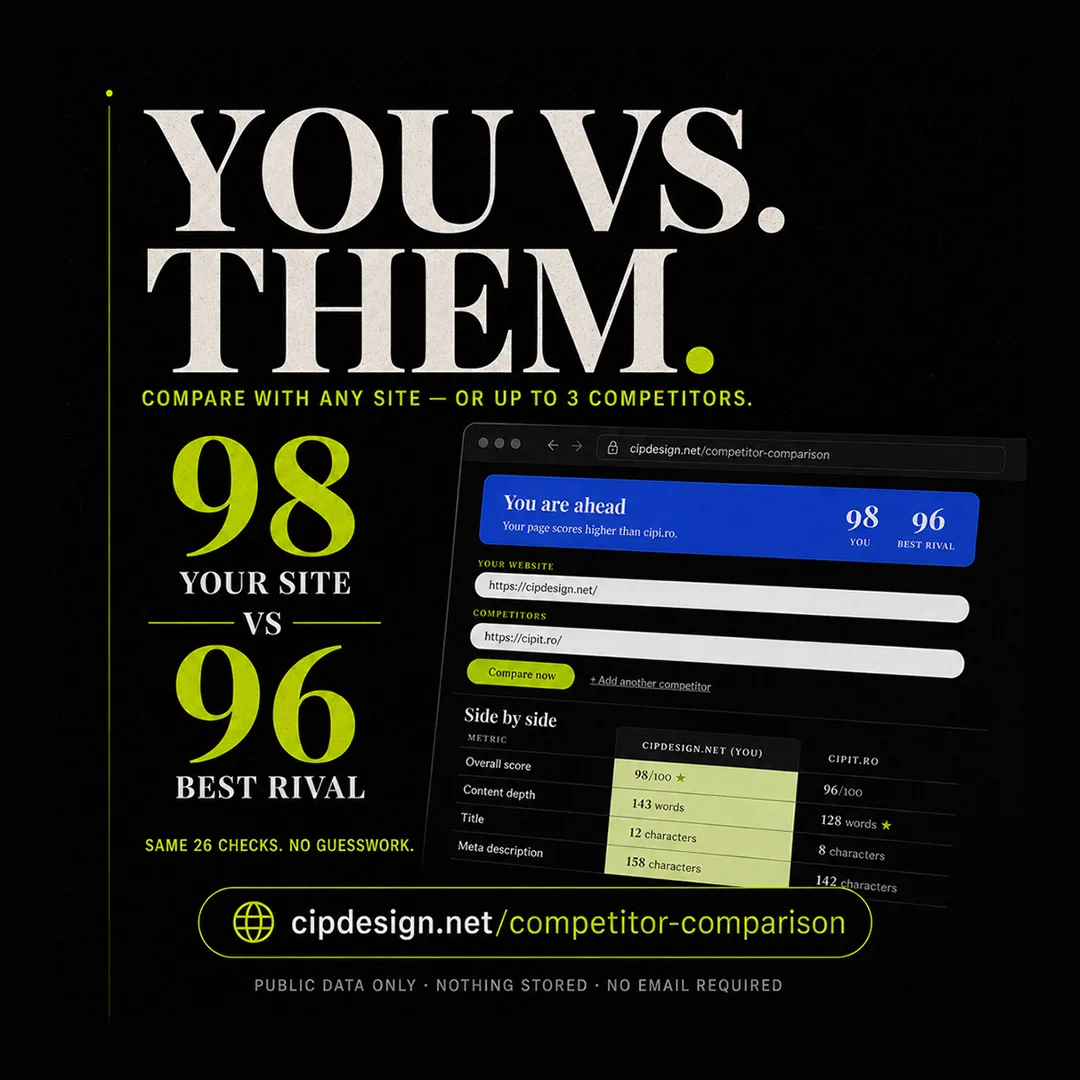
The tool allows you to compare your website with up to three competitors, using the same 26 checks for every page.
The analysis includes elements such as:
- overall score;
- content depth and structure;
- server response time;
- page weight;
- images missing alternative text;
- internal links;
- structured data types;
- title length;
- other technical and on-page SEO elements.
The results are displayed in a single table, allowing you to see which website performs best for each metric.
You are no longer comparing impressions. You are comparing publicly available data measured under the same conditions.
From “Their Website Looks Better” to Measurable Differences
For many businesses, competitor analysis remains largely visual:
“Their website looks more modern.”
“They probably have better SEO.”
“They have more content.”
“Their website seems to load faster.”
These impressions may be accurate, but they are difficult to turn into decisions.
Once every page is evaluated using the same checks, the differences become much clearer. You can see whether a competitor genuinely has more substantial content, a faster server response, more internal links, or a structure that search engines can interpret more easily.
The conversation changes.
“These are the three areas in which our strongest competitor is ahead of us, and this is the gap we should address first.”
Your Three Biggest Gaps Become Your Priority List
A report containing dozens of observations can create more confusion than clarity.
Where should you begin? What should be fixed now? What can wait?
CipDesign Competitor Comparison identifies the three largest gaps between your website and the strongest competitor included in the analysis.
These may not be the only issues, but they provide a logical starting point. Instead of trying to fix everything at once, you begin where the difference is greatest.
Make the improvements, run the comparison again, and watch the results change.
Website optimisation becomes a measurable process:
- identify the gaps;
- set your priorities;
- implement the improvements;
- run the comparison again;
- check whether you have closed the gap.
How Do You Choose the Right Competitors?
This is where many comparisons go wrong.
The companies you consider your business competitors are not always the websites you are competing against in search results.
For a meaningful comparison, open an incognito browser window and search for the phrase a real customer would use, such as:
- “dental clinic Iași”;
- “web design for small businesses”;
- “wedding photographer Bucharest”;
- “epoxy flooring installer”.
Choose the first organic results belonging to actual businesses rather than advertisements, directories, or marketplaces. These are the websites currently occupying the positions you may want to reach.
It is equally important to compare pages with the same purpose:
- homepage against homepage;
- service page against service page;
- product page against product page;
- article against article.
Comparing a homepage with a 3,000-word article may produce a score, but not necessarily a useful conclusion.
What Does the Report Include?
The report is designed to provide the conclusion first and the details afterwards.
A Clear Verdict
You can immediately see whether your website is ahead of or behind your strongest competitor and by how many points.
A Side-by-Side Comparison
Every page is assessed using the same criteria. The winning website is highlighted for each metric, while your own website remains easy to track throughout the table.
Your Three Largest Gaps
The report identifies the categories in which your strongest competitor outperforms you by the widest margin. These can become your initial work priorities.
A Complete Audit of Your Page
You also receive the results of all 26 checks performed on your own page, together with clear explanations. This allows you to move directly from comparison to improvement.
What Can the Tool Not Measure?
A trustworthy comparison should also acknowledge its limitations.
The tool analyses publicly available information found on the pages you submit. It cannot evaluate:
- the complete backlink profile;
- the age and history of the domain;
- Google Business Profile reviews;
- long-term brand authority;
- how effectively the copy converts a visitor into a customer;
- the full relationship between the content and search intent.
A competitor may have a technically weaker page and still rank higher because of domain authority, accumulated backlinks, brand recognition, or stronger overall relevance.
This is precisely where the comparison becomes valuable.
If your page matches or outperforms competing pages from a technical and on-page perspective but still ranks below them, you know that the problem may lie elsewhere. You can investigate off-page SEO, authority, content relevance, or other factors instead of continuing to spend money on the wrong improvements.
Does a Higher Score Guarantee Better Rankings?
No.
Google does not rank pages according to a single score, and this tool does not claim otherwise. Rankings depend on many factors, including content relevance, domain authority, backlinks, website history, search intent, and the context of each query.
A stronger comparison score does mean that you have reduced some of the technical and structural disadvantages you can control.
It does not guarantee that you will win the race, but it helps ensure that you are no longer starting with the brakes on.
Public Data, No Account, Nothing Stored
You do not need to create an account or provide an email address to run the comparison.
The tool uses only publicly available information from the submitted pages. Each page is requested once, much like it would be by a search engine crawler. The tool does not attempt to access private areas or scan websites for vulnerabilities.
Public data only. Nothing stored. No email required.
Stop Chasing Perfection. Start Closing the Gaps That Matter
A website should not be optimised simply to achieve an impressive score in a report. It should be improved so that it communicates more clearly, is easier to understand, and competes more effectively.
CipDesign Competitor Comparison shows you where your website stands, which competitors are ahead, and which differences deserve your attention first.
Enter your page, add up to three competitors, and compare results generated through the same 26 checks.
Because your website does not need to be perfect. It needs to be strong enough to outperform the websites currently ranking above it.