
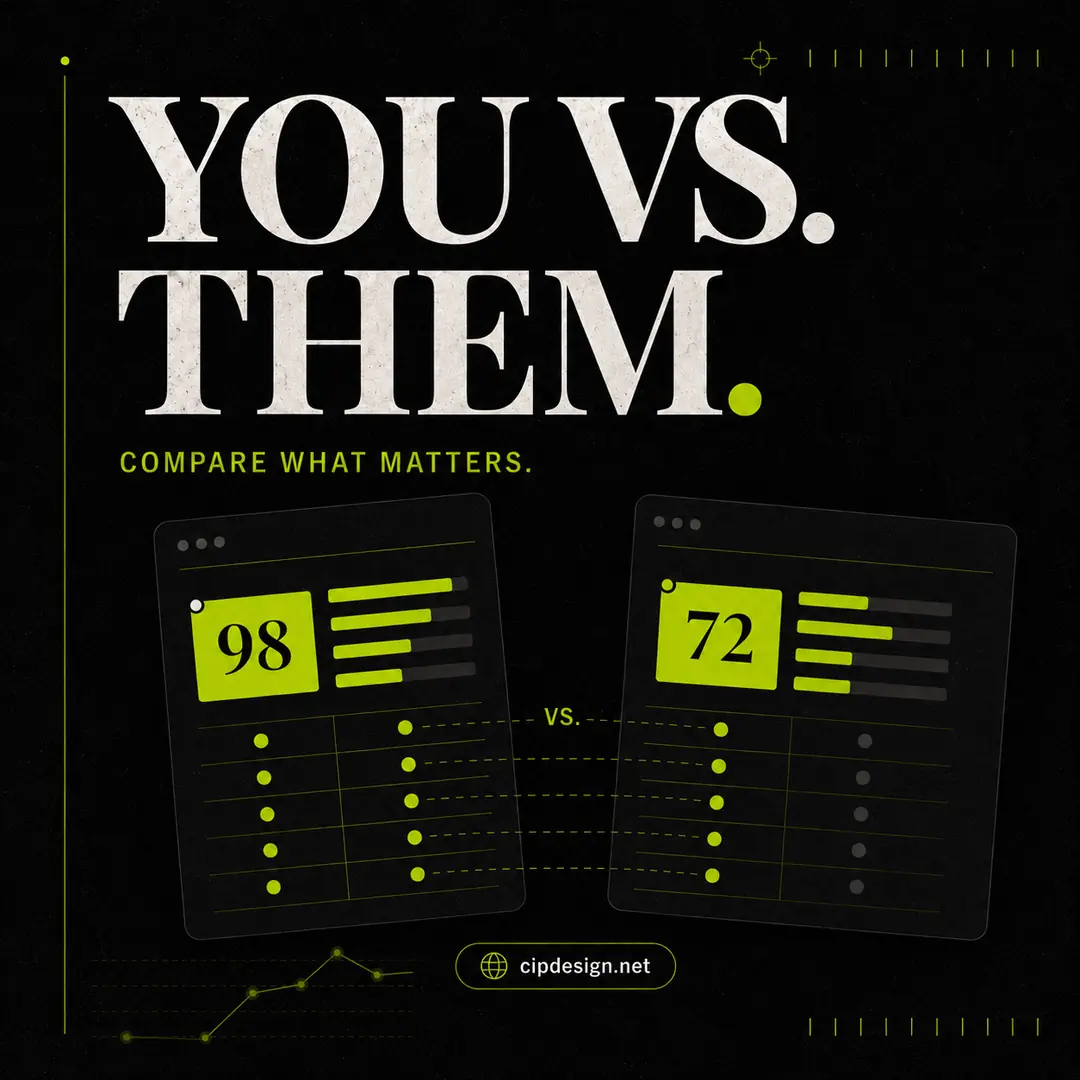
Your most visible offline competitor is not always your strongest competitor in Google. Search results are shaped by the phrase, location and intent behind a query. That is why a useful comparison begins with evidence, not a familiar company name.
Choose search competitors, not just business rivals
Open a private browsing window and search the phrase a prospective customer would use. For a local company, include the service and city. Ignore advertisements, broad directories and marketplaces if they do not represent businesses similar to yours. Select up to three organic results that compete for the same customer and search intent.
The free website competitor comparison tool lets you compare your page with as many as three competitors using the same 26 checks.
Compare equivalent pages
Page selection can make or break the analysis. Compare a homepage with homepages, a service page with matching service pages, or a product page with equivalent product pages. Comparing a short contact page with a detailed guide will tell you which page contains more text, but not which business has the stronger strategy.
Use exact URLs rather than domains whenever a specific page targets the keyword. This keeps the comparison focused on what a visitor actually sees after clicking a search result.
What should you compare?
Overall technical foundation
Review the overall scores, but do not stop there. Two pages can receive similar totals for very different reasons. One may have strong content and weak performance; another may be fast but thin. The category-level gaps tell you what to do next.
Content depth and structure
Look at heading hierarchy, title length, internal links and whether the content answers the likely search question. Do not copy a competitor’s wording. Identify useful subjects they cover that your page omits, then provide a clearer or more specific answer in your own voice.
Speed and page weight
Compare server response time, page size and image handling. If competitors deliver a much lighter page, inspect your hero images, sliders, video backgrounds and unnecessary scripts before blaming the hosting provider.
Search signals
Titles, descriptions, canonical tags and structured data help search engines interpret a page and can affect how it appears in results. Missing signals are often relatively quick to fix, which makes them good early priorities.
Turn the three biggest gaps into a work order
A long report can create paralysis. Begin with the widest category gap against the strongest relevant competitor. Estimate the effort and business value of fixing it, then choose the improvement with the best balance.
- Record the current comparison.
- Fix one meaningful group of issues.
- Run the comparison again.
- Keep changes that improve the page for both visitors and search engines.
Understand what an on-page comparison cannot prove
No public page comparison can fully measure backlinks, domain history, Google Business Profile strength, reviews, brand demand or conversion quality. A higher technical score does not guarantee a higher ranking. It removes avoidable disadvantages and helps reveal when the remaining problem is likely off-page.
Before comparing, you can run a single-page website audit to understand your own results. Then compare the same page with the sites that actually outrank it and work from the largest credible gap.